
Safety: a priority
With more and more of us on the trails, let’s ride our snowmobiles safely—for ourselves, for others, and to preserve our passion.
Safety is our top priority
Let’s snowmobile safely—for ourselves, for others, and to preserve our passion.
A partner of the FCMQ in promoting snowmobile safety. Your safety is our top priority.
FCMQ Initiatives
Priority is given to updating and implementing effective signage, as well as to special trail services.
The FCMQ provides publications to help you plan excursions safely.
Clear access to information regarding the laws and regulations governing snowmobiling.
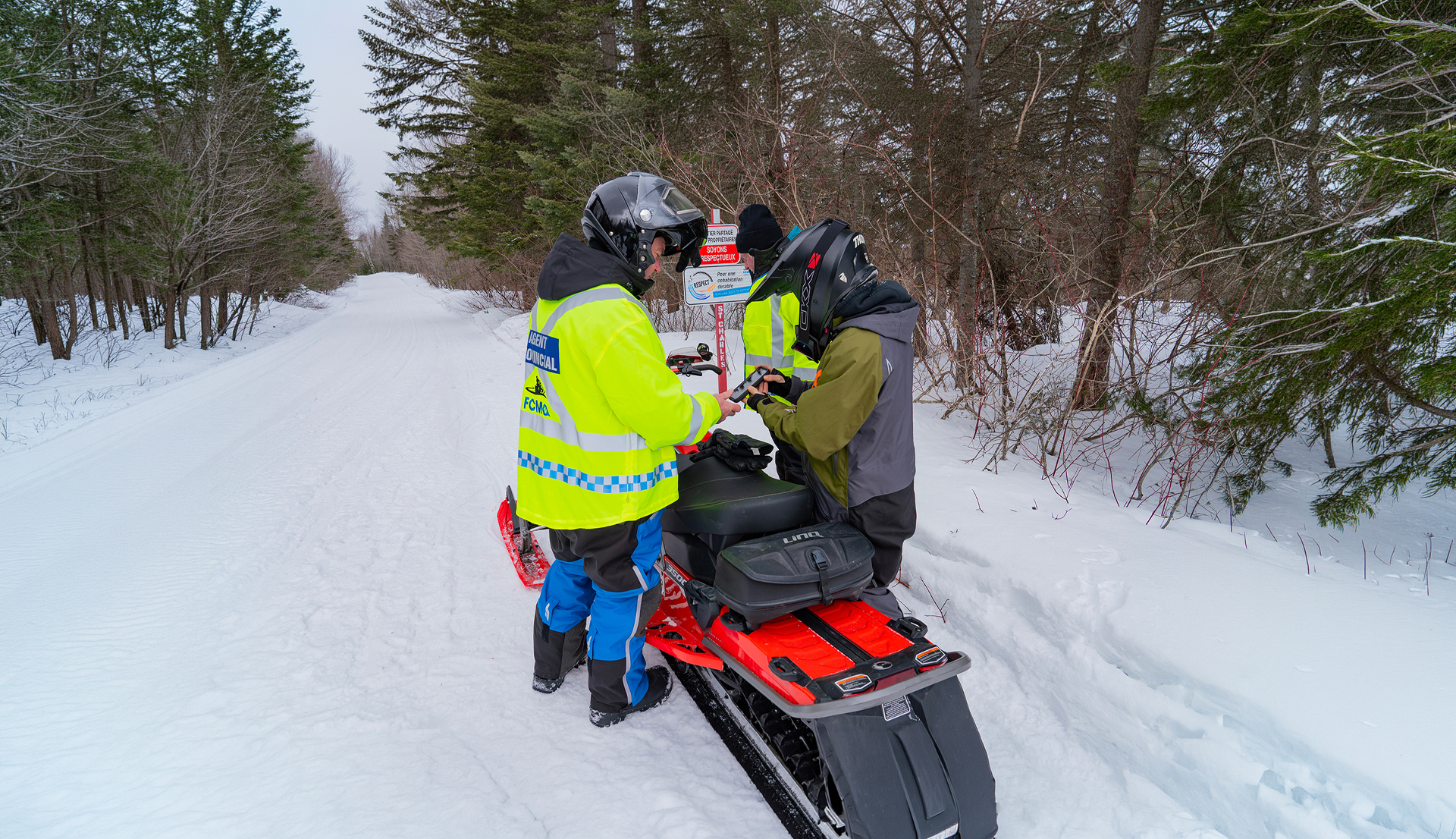
Volunteers from the FCMQ visit the clubs and carry out patrols, in collaboration with the police and the clubs’ security officers. Their snowmobiles are fitted with flashing lights and are clearly marked.
Take responsibility for your own safety
To drive legally and safely, you must have the following documents.
Mandatory documents
Best Practices Before You Leave
Ice thickness and strength can vary considerably from one area to another on the same body of water.
When snowmobiling across a body of water, always stay within marked trails.
The ice thickness along these trails has been checked before the trail is opened.
Never venture off marked trails onto an ice-covered surface.
Snowmobile license
Article 16 — To operate a snowmobile, you must be at least 16 years old, hold a certificate of competence (authorization to operate a snowmobile), and have a valid driver’s license.
Training and Certificate of Competency — ConduiPro
The FCMQ has authorized the ConduiPro driving school network to provide this training and issue a certificate of completion to candidates who have successfully completed the theory course.
For more information: 1-877-766-3443.
A valid driver’s license is also required to operate a snowmobile—see the SAAQ’s requirements.
Have proof of authorization to drive an OHV (in accordance with the laws of your place of residence) and hold a valid driver’s license. Please note: Even if your province or state allows you to drive before age 16, you may not drive in Quebec until you have reached the minimum age of 16.
How to prepare before you leave
- Your FCMQ trail permit (affixed to the snowmobile; keep the documents handy)
- A valid driver’s license
- Proof of age
- The certificate of competence for 16- or 17-year-old drivers
- The snowmobile registration certificate
- Proof of $1,000,000 in liability insurance
- A rental agreement (if applicable)
Laws and regulations
The Act respecting off-highway vehicles regulates the use and operation of off-road vehicles on both public and private lands.
“It is prohibited to drive on public roads, except in rare cases provided for by law. You may cross a public road or drive on it only if traffic signs permit it.” For more information: what the SAAQ says.
Off-trail
The FCMQ encourages you to enjoy off-trail snowmobiling responsibly and only in permitted areas.
Reminder: A valid trail permit is required whenever you use a federated trail to access an off-trail riding area.
A unique and demanding world
Accident statistics show that trails remain the safest place to enjoy snowmobiling, thanks to the ongoing efforts of thousands of volunteers.
Off trail, hazards such as ice, rocks and stumps can be hidden beneath the snow and appear when least expected. Even at low speeds, certain manoeuvres can become dangerous. Snowmobilers with limited off-trail experience are therefore strongly encouraged to take a training course to maximize both safety and enjoyment.
That is why it is strongly recommended that snowmobilers who are not used to off-trail riding undertake training, to maximise enjoyment and safety.
Impact on the environment
Unlike trails (which are limited in area and subject to heavy use), off-trail travel covers vast areas and has a significant impact on the environment. Possible impacts include:
To minimise these impacts: avoid riding where you risk damaging trees or forest regeneration (especially when there is little snow); slow down or switch off the engine if you come across animals; slow down when near other users of the area. The following are strictly prohibited and liable to fines: chasing or harassing wildlife, damaging trees or hindering forest regeneration.
Where to ride
Choosing where to ride is one of the biggest challenges of off-trail snowmobiling. For your safety, avoid hazardous areas such as waterways and places where obstacles may be hidden beneath the snow.
From a legal standpoint, always make sure you have permission to ride. Quebec Act Respecting Off Highway Vehicles provides for significant penalties for riding without authorization. Snowmobiling is also prohibited at all times in certain areas, including national parks and ecological reserves.
Unauthorized riding can also negatively impact snowmobile clubs, particularly by causing the loss of trail land-use permissions, and ultimately jeopardise the activity itself.
Sustainable development
The FCMQ has adopted its first Sustainable Development Action Plan, a firm commitment to embracing sustainable principles and aligning with the Quebec government’s strategy. This three-year plan outlines a series of actions to achieve seven major objectives.
February — National Snowmobile and Environment Month
Let’s respect the environment this month and throughout the year. For snowmobiling to continue, we need to strike a balance between our passion for the sport and our respect for nature.
Pick up your dog’s waste and dispose of it in a designated area. Waste bags are inexpensive and easy to carry.
A snowmobile in good condition reduces emissions, fuel consumption, and leaks. Keep the original exhaust to avoid scaring animals.
Do not chase or startle animals. Slow down or turn off the engine if you come across any.
Sustainable snowmobiling is snowmobiling that takes place under conditions that responsibly take into account respect for the environment, local residents, and snowmobilers.